Functional Monitoring
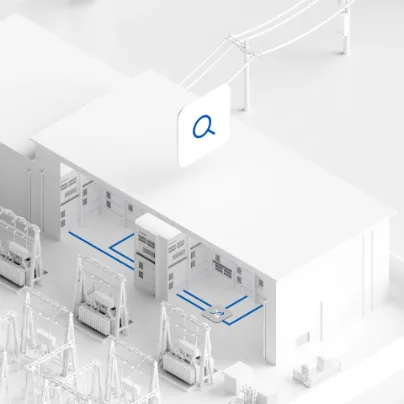
Upholding Stability in Complex Automation Networks
Automation systems in substations and power plants are validated during commissioning. However, risks often emerge later during operation due to maintenance activities, configuration changes, timing deviations, or device malfunctions.
Without continuous monitoring, these issues may go unnoticed until they affect system stability or cause outages.
Functional monitoring (or asset health monitoring) continuously observes the network, helping your team detect deviations from intended communication behavior, recognize configuration inconsistencies, and automatically document critical operational events.
This lets you maintain reliable operation over time.
Challenges
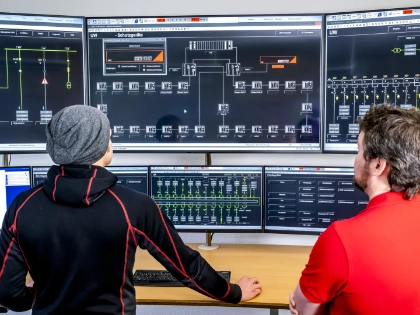
Complex OT Network Visibility
Modern power systems are evolving – and so are automation stability risks.
From Commissioning to Operation
Systems are validated once, but changes during maintenance or expansion are rarely verified with the same depth. Over time, a system’s actual behavior can deviate from its intended design.
Hidden Changes in Live Systems
Configuration updates, firmware changes, or engineering activities can introduce unintended effects that are difficult to detect during normal operation.
A Lack of Continuous Validation
After commissioning, there is often no mechanism to continuously verify that communication and system behavior remain consistent with the original design.
Complex Interactions Between Devices
Modern automation systems involve many interdependent devices and protocols. Small deviations in one component can lead to unexpected behavior elsewhere.
Scaling Complexity
Automation systems span multiple substations, generations of IEDs, and mixed technologies – making manual oversight increasingly difficult.
Important Functions
Clarity and Control in OT Networks
High Availability
Substation automation systems operate under strict availability requirements. Monitoring solutions must integrate seamlessly into live environments without interrupting protection or control functions.
Operational Clarity
Continuous monitoring increases the visibility of communication behavior and automation performance, improving transparency across complex substation networks.
Faster Analysis
Structured event logging and contextual insights support efficient troubleshooting. Monitoring bridges commissioning and long-term operation, strengthening confidence in system stability.
Low Effort
Monitoring should minimize false positives and require limited manual configuration. This reduces operational workload and allows engineering teams to focus on critical tasks.
Scalable Design
Automation environments often span multiple substations and include a mix of IED generations, requiring consistent, scalable functional monitoring throughout different systems.
Recommended Solutions
Find The Right Solution for Your Application
Supporting Products
Daily Continuous Monitoring
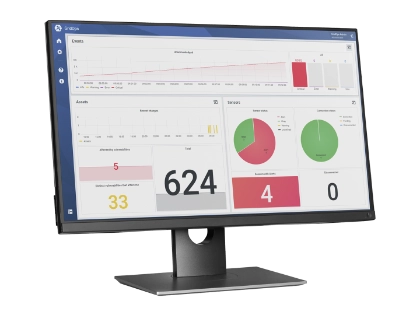
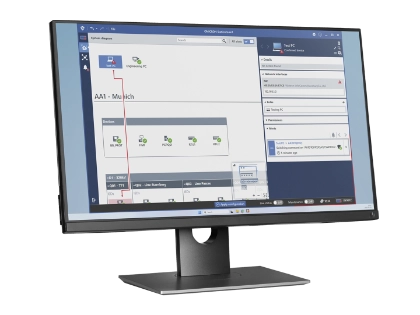
Our functional monitoring tools provide you with data collection and centralized operational visibility. StationGuard Sensor continuously monitors live automation traffic, identifying substation deviations in real time. At the same time, GridOps consolidates your data from multiple sites, structures alerts, and simplifies asset management, enabling direct oversight of all your systems.
Related Products
Energy Talks
Related Podcast Episodes


Cybersecurity Website
Dive Deeper Into Functional Monitoring
You can learn even more about our functional monitoring offers by visiting our cybersecurity website. What’s the logic behind recognizing faults, malfunctions, and critical events in your systems? Discover it here:
Can StationGuard Sensor distinguish between a cyberattack and a legitimate configuration change made during maintenance?
Yes. StationGuard Sensor addresses this issue with its dedicated Maintenance Mode feature. During planned maintenance or commissioning, this mode restricts network access to pre-approved activities, engineering PCs, and test equipment - significantly reducing false positives. You can define exactly what is and isn’t permitted and activate/deactivate it with a single click. Outside maintenance windows, StationGuard Sensor continuously monitors IED configuration revision fields 24/7 and cross-checks IEC 61850 parameters with SCL files, so any unauthorized change is immediately flagged as an anomaly.
Can StationGuard Sensor be used to validate the intended system configuration during the commissioning phase?
Yes. StationGuard Sensor can validate the intended system configuration during commissioning. It compares all live network communication with defined inputs and/or IEC 61850 SCL files. It instantly detects configuration errors such as incorrect VLAN settings and GOOSE parameters, as well as faulty data sets. Failed control commands in MMS and IEC 60870-5-104 are logged automatically. Combined with Maintenance Mode, which limits network access to registered engineering PCs and test equipment, commissioning teams get real-time validation and a complete audit trail.
Do I need functional monitoring when I already have an intrusion detection system?
Yes, with StationGuard Sensor, you get them both in one device. Intrusion detection focuses on identifying cyberattacks, but many critical OT issues aren't attacks: misconfigured GOOSE parameters, VLAN errors, IED failures, time sync drift, or failed control commands in MMS/IEC 60870-5-104. A standard IDS won’t detect these issues. Functional monitoring identifies communication problems, interoperability issues, and configuration errors that directly impact supply security. StationGuard combines both capabilities, so you can detect threats and operational malfunctions - without deploying separate systems.
Looking for some guidance on this topic?