News
Safe Timing Measurements on Circuit Breakers Using Grounding on Both Sides
August 13, 2026
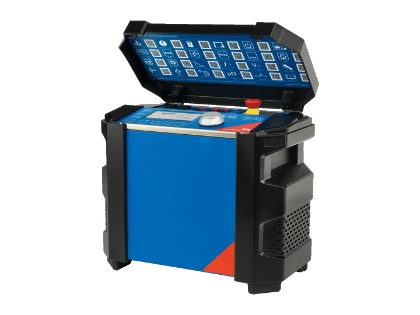
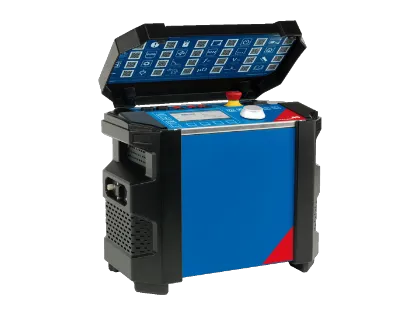
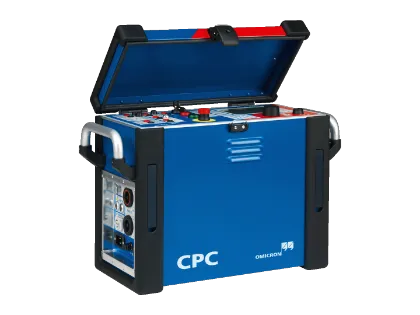
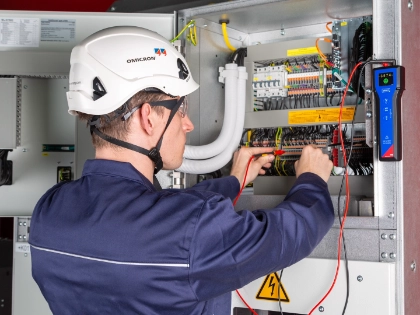
Using the CPOL3 with one of our test devices, such as the CPC 100, COMPANO 100, provides a wide range of wiring and polarity testing options.
The new functions of the CPOL3 offer even greater testing flexibility.
By measuring the voltage and displaying the signals, polarity checks can be combined with additional information to detect the most common wiring errors. This approach serves as a foundation for several valuable applications and opens the door to various alternative testing methods.
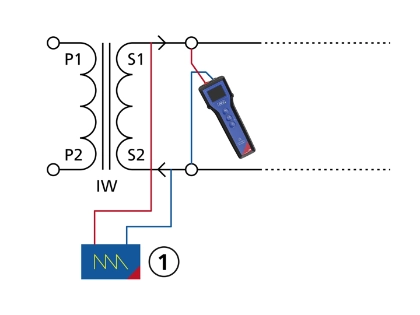
The polarity of a current transformer can be verified by injecting a sawtooth signal into the primary side using a CPC 100, a CMC test set, or a COMPANO 100. The polarity on the secondary side can then be checked with the CPOL3.
[1] Test set
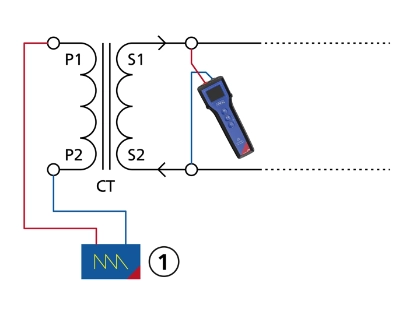
After verifying the polarity of the current transformer, you can inject the signal on the secondary side. This allows you to test the polarity of the terminals all the way to the protective relay using lower currents. If you use the nominal current for the test, you can even determine the load directly from the measured voltage.
[1] Test set
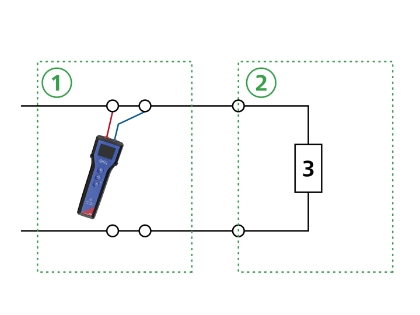
The CPOL3 has such high measurement sensitivity that the terminals can act as a shunt to capture the signal for polarity measurement, with the nominal current usually being sufficient. To achieve this, the polarity is measured at various points along the current path, with the voltage decreasing towards the load. Since terminal points are generally easy to access, this method allows all terminal points to be checked for the correct sequence.
[1] Terminal| [2] Relay or meter| [3] Burden
The test signal is typically read and evaluated directly with the CPOL3, which is simple, safe, and fast. However, in some cases, interference from other phases can occur, and direct measurement is less suitable for self-powered relays. In such situations, testing with a current clamp is recommended. The only drawback is that accessing the secondary wiring with the current clamp can sometimes be challenging.
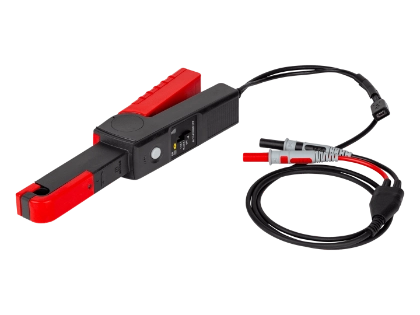
In current transformer circuits with a shared return conductor, the current flow causes a voltage drop in both the forward and return conductors. The return conductor's voltage drop can result in signal detection from other phases during a voltage measurement. Although this signal is smaller, it can still lead to false interpretations. Combining the CPOL3 with a current clamp eliminates interference from other phases, allowing you to measure the current directly.
Self-powered relays often incorporate an integrated switched-mode power supply, which can distort the voltage in the terminals, especially when using low testing currents. Higher current amplitudes typically result in less voltage distortion. Since the current remains undistorted and can be used to detect polarity, CPOL3 measures the current with a clamp rather than measuring the voltage.
Coupling capacitances of 1 nF or more can occur in long parallel lines within the secondary wiring. The load in a voltage transformer circuit's relay or meter typically has very high resistance. Together with the coupling capacitance, this forms a capacitive-resistive voltage divider, creating coupling between the phase under test and other phases. CPOL3 addresses this issue with a low input impedance mode (LoZ) that effectively suppresses such effects.
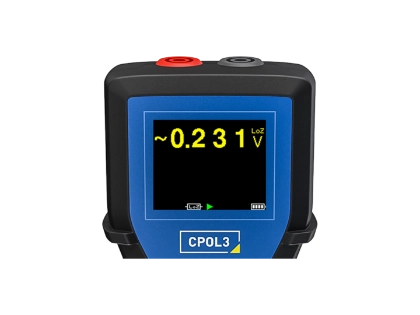
Test switches or plugs are crucial for ensuring safety when replacing or testing meters and relays in current transformer circuits. The COMPANO 100 features an “interrupt trigger” function that allows for safe test current injection and polarity testing when used with the CPOL3. If a test switch is present, it can be activated multiple times (The test switch might be triggered during the test current's zero crossing; however, this is rare). If CPOL3 no longer indicates polarity, it suggests that COMPANO 100 has detected an interruption and halted the output. The COMPANO 100 will then display the duration of the interruption, signaling a potential issue with the test switch, which must operate without disruption.