News
Safe Timing Measurements on Circuit Breakers Using Grounding on Both Sides
August 13, 2026
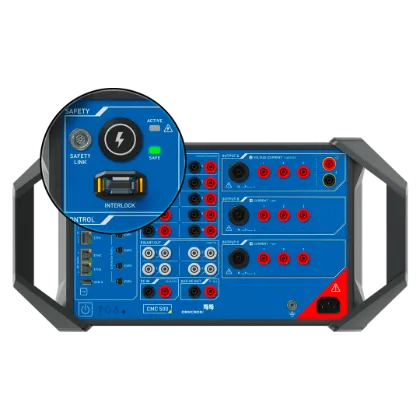
The CMC 500 sets new standards in electrical testing technology. Its performance and precision, automatic test procedures, and versatility are all hugely impressive. However, particularly noteworthy are the advanced safety features, which establish a new industry standard for personal safety.
This focus on safety is no coincidence, since the growing electrification of all aspects of our life, at work and at home, increases the demands placed on protection mechanisms. The testing of electrical energy and protection systems, where high voltages and complex procedures collide, exposes engineers to a higher risk from electrical hazards. Safety in the field of electrical testing technology has thus become the benchmark against which every test set has to be measured.
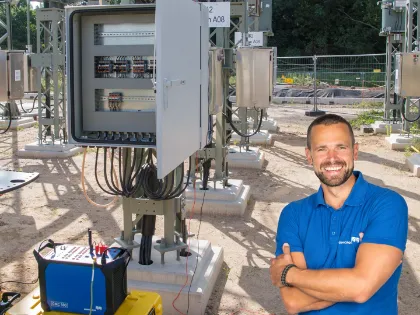
Innovative safety functions are characterized by the fact that they increase levels of personal safety yet at the same time have no adverse effect on productivity.
Dangers posed by the environment
Dangers posed by the test set or the testing procedure
The safety measures that have been adopted in the field are often derived from standards and subsequently enhanced by the imposition of operational requirements. Typical measures, for example, might include: work instructions, safety training courses, personal safety equipment (PSE), risk assessments, safety indexes.
The "5 safety rules", which are now internationally accepted when working on electrical installations, are particularly important:
1. Insulate
All system components must be completely disconnected from the power system – including possible return voltages.
2. Secure to prevent reconnecting
Secure switchgear, e.g., with interlocks or warning signs, to prevent unintentional reconnection.
3. Verify that the installation is dead
Using suitable measuring equipment, test each conductor to ensure it is not live. A voltage may be caused by a feedback loop or another test set.
4. Carry out grounding and short-circuiting
First connect to the grounding arrangement and then to the system component. All connections must be securely connected and short-circuit proof.
5. Provide protection from adjacent energized parts
If adjacent live parts cannot be switched off, cover or shield them.
Safety standards are at the heart of personal safety in the development of tests sets. IEC 61010-1, ISO 13849-1 (incl. IEC 61508-3), and EN 50191 are particularly relevant.
IEC 61010-1: Safety requirements for electrical equipment for measurement, control, and laboratory use
IEC 61010-1 specifies the general safety requirements for electrical equipment for measurement, control, and laboratory use. Its objective is to minimize the risk for users and the environment. Among other points, it stipulates the protective measures that will eliminate electrical, mechanical, and thermal hazards, and prevent the spread of a fire that might be caused by a faulty device.
ISO 13849-1: Functional safety
This standard describes how the control components (including software) that are important in terms of safety have to be configured. The objective is to minimize the chances of a dangerous error occurring. The standard has been extended by the inclusion of IEC 61508-3 for the software. It applies regardless of the type of technology, in other words it applies to electrical, mechanical, and hydraulic systems.
EN 50191: Erection and operation of electrical test equipment
This European standard governs the installation and operation of electrical test installations. Among other things, it includes requirements for protective measures, personnel, testing procedures as well as, for example, the signaling using lamps (red/green) to indicate operating statuses.
The CMC 500 redefines the meaning of safety in the field of electrical testing technology. Featuring safety functions conforming to international standards, it offers the highest levels of reliable and tested protection.
Sophisticated features, such as status lights, the operational mode button, the interlock key, and Safety Link, ensure that personal safety is not just guaranteed, but also integrated intelligently into the testing process – without compromising efficiency or user-friendliness.
Tune in to our podcast series "CMC 500 - From Concept to Benchmark for Personal Safety".